
Frederick City Directory Holdings
Frederick directories survive in pieces, not one run. Start with the Maryland State Archives city-directory guide. It cites an 1875 Boyd's business reference for Frederick. That lead, on the SC2779 microfilm, reportedly spans 1875 through 1911, though the Frederick entries still need checking volume by volume. Later catalog records identify a 1967 Frederick City Directory and a 1976 Polk's Frederick directory. Holdings are leads, not proof. No catalog entry guarantees that every year or household made it into print.
| Collection | Years | Where Held | Access |
|---|---|---|---|
| Boyd's Business Directory of Maryland, Frederick lead | 1875 | Maryland State Archives city-directory guide and SC2779 microfilm route | Online holding guide, then microfilm or reference route |
| Directory collection identified by SC2779 | 1875-1911 | Maryland State Archives special collections | Confirm Frederick volumes before requesting |
| Frederick City Directory, BRG29-10 | 1967 | Maryland State Archives series record | Catalog and archive request |
| Polk's Frederick city directory accession | 1976 | Maryland State Archives library accession record | Archive reference route |
| Frederick County White and Yellow Pages | 1937/38-1943/44 | Library of Congress digital collection | Free online page images |
Telephone volumes at the Library of Congress include Frederick alongside other county communities, so the town or exchange heading matters as much as the name. Coverage differs by format. A business directory is not an alphabetical household listing, and a telephone book carries its own limits. Before a name-and-address pair becomes a research lead, write down the exact title, year, page, and heading. Small details anchor the citation. Loose notes breed loose conclusions.
Note: A missing year, damaged page, or absent name marks a collection gap, not a person's absence from Frederick.
Frederick City Directories at Maryland Room
Local history lives at the Frederick County Public Libraries Maryland Room, housed at C. Burr Artz Library. The collection does not circulate, but it more than makes up for that. Researchers digging into Frederick City and Frederick County will find over 11,000 volumes, family histories, the O'Donoghue Index, and John Stanwood Martin's four-volume Genealogical Index to Frederick County. Personal-paper groups add further depth, covering biographical files, local landmarks, schools, veterans, and civic material. Together these sources can put a printed directory entry in richer context.
One gem is the staff-assisted Linton Obituary Collection. It works well as a follow-up after a directory find. More than 250 surname-organized card drawers reach back to 1932, with maintenance through 2010 and later additions compiled by staff. Plan ahead and request it at least a week in advance. A surname card or clipping is still just a lead, though. Pair it with a cemetery, land, vital, newspaper, or court source before you claim a family connection.
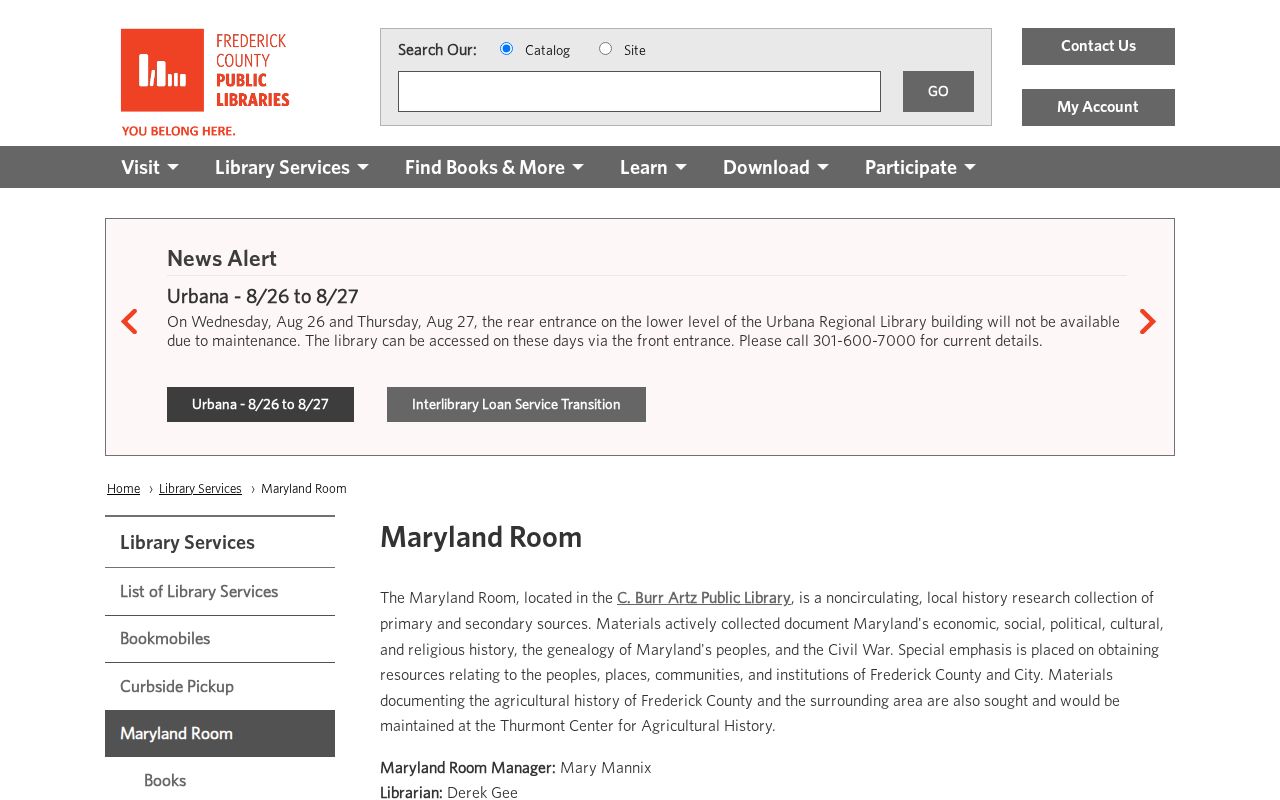
The Maryland Room collection page describes the local-history materials, research contact, and access setting for Frederick directory work.
Match the route to the question. A phone call, a letter, or an in-person visit each suits a different surname, year, or printed address. Remote questions go straight to the Maryland Room. Reference help is free; photocopies cost $0.20. Out-of-state or non-FCPL-card requests run $20 prepaid, covering up to two hours, five photocopies, and postage. Extra time costs $10 an hour. Targeted archival boxes may be unavailable at night or on Sunday, so call before a visit.
Frederick City Directory Years and Gaps
Timing shapes how a Frederick directory should be read. A HABS bibliography for 59-61 South Market cites T. J. C. Williams's Frederick Directory City Guide and Business Mirror, an 1859-60 volume published in 1860. It offers no verified page for a named person. The Maryland State Archives guide carries the story forward with its 1875 Boyd's business lead. Library of Congress telephone pages cover 1937/38 through 1943/44. Later come a 1967 series record and a 1976 Polk's accession. They mark shelves, not continuity.
| 1859-60 | Williams directory citation in the HABS bibliography for 59-61 South Market. |
|---|---|
| 1875 | Boyd's business-directory reference in the Maryland State Archives guide. |
| 1937/38-1943/44 | Frederick County White and Yellow Pages available through the Library of Congress. |
| 1967 | Frederick City Directory series BRG29-10 at the Maryland State Archives. |
| 1976 | Polk's Frederick city-directory accession at the Maryland State Archives. |
Courthouse history offers a caution for early Frederick research. The county seat's first courthouse site was deeded in 1750, and the building itself was accepted in 1756. Fire destroyed it in 1861. State Archives historians call no major record series incomplete. Search the land, court, probate, and archive series directly instead of assuming everything burned. The 1864 ransom paid to spare Confederate destruction is local color, not evidence about any individual directory entry.
Reading Frederick City Directory Entries
Every entry is a dated lead. Printed format shifts with publisher and year. Never fill in a missing spouse marker, address, trade, or phone number from memory. Capture the year and page before anything else. In a telephone volume, the exchange or town heading can matter as much as the name. A firm listing in a business volume should never become a household claim.
| Printed placement | Directory year, page, alphabetical or business section, and city or exchange heading. |
|---|---|
| Identity text | Surname, given name or initial, household marker where printed, business or institution name, and trade descriptor where printed. |
| Address text | Street name and number, room or unit if printed, post-office or town label, and telephone exchange or number in telephone books. |
| Linked clues | Same surname at an address, adjacent alphabetic entries, business and residential listings, a reverse section, or a newspaper and land-record lead. |
| Limits | Damaged pages, OCR errors, incomplete coverage, and a listing's inability to prove residence on a particular day. |
- Criss-cross section
- A street-order portion of a directory, if that volume includes one. It can lead from an address to printed listings but is not a modern parcel record.
- Householder index
- An alphabetical arrangement of people or households printed by that publisher. Its scope follows the book, not the whole city.
- Abbreviation key
- The publisher's explanation of shortened words and marks. Photograph or transcribe it before interpreting unfamiliar text.
Frederick City Directory Page Capture
Capture the page itself whenever a Frederick city directory entry is open. Snippets and OCR text are starting points, nothing more. The record to keep is the printed title and the directory year. It also includes the page number and every spelling exactly as it appears. A telephone scan adds its exchange or locality heading. An archive result adds its series or accession number. An image identifier or stable URL keeps the lead findable again. This holds true even after a gallery view changes.
OCR earns its keep for locating a surname, street, church, or institution. That reach covers Heritage Frederick PDFs and newspaper scans. Old type breaks, abbreviations confuse, and damaged text misleads. Read the page image for every word that fixes an identity or an address. When no image has been inspected, call the result what it is: an index or catalog lead. No verified Frederick directory page with a named resident is held here. So no sample name belongs in these notes.
Match the printed place label too. An old record may read Frederick-Town, Frederick County, a post-office label, or the present City of Frederick. Keep the original wording until date, jurisdiction, and address form all agree. A map or a companion record can confirm that match.
Frederick City Directory Cross-Checks
One Frederick city directory entry rarely stands alone. The HABS file for 59-61 South Market proves it. The bibliography connects the Williams 1859-60 directory citation to Henry Koester's 1862 confectionary and bakery reference. It also ties in deed Liber JWIJC 1 Folio 83, will GME2 Folio 96, and Sanborn maps dated 1887, 1892, 1897, 1904, 1911, 1922, and 1930. Each source answers a different question. A business reference supports a commercial association. A deed tracks legal title. A map records a dated footprint.
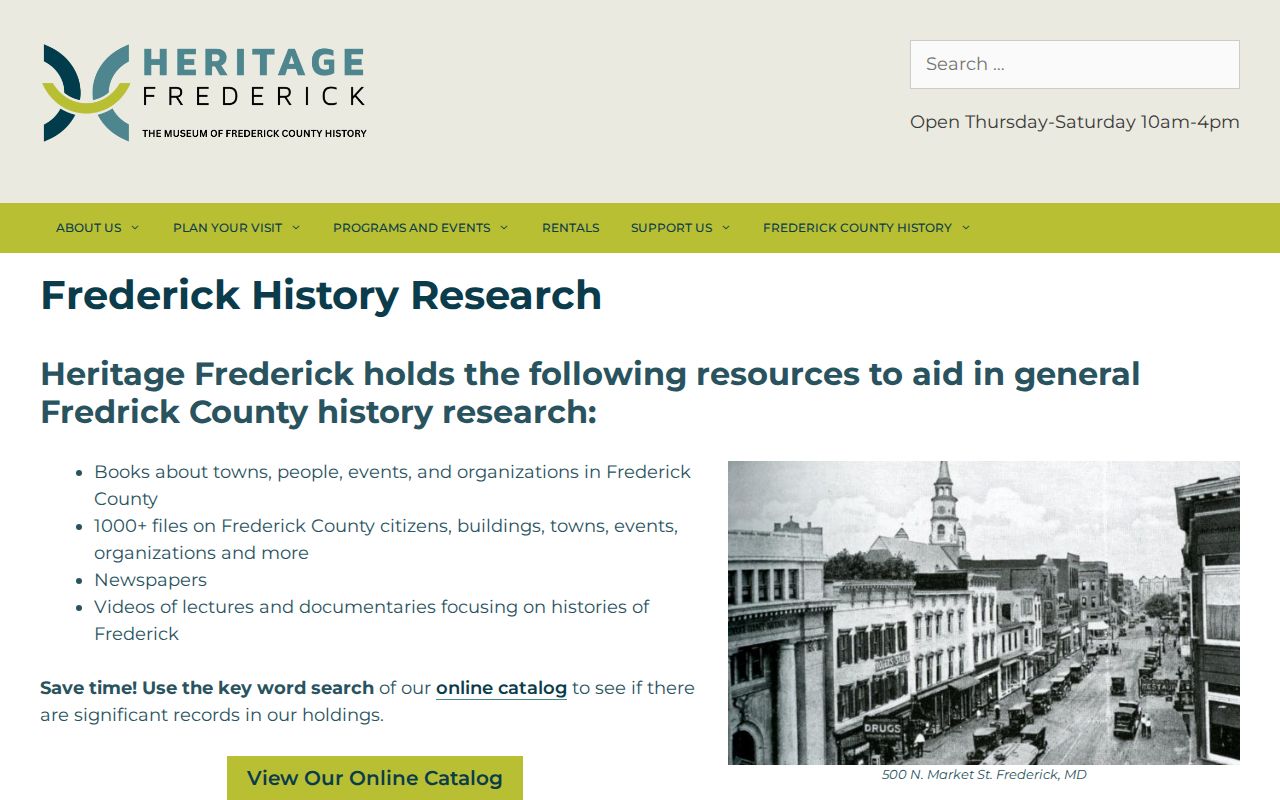
Heritage Frederick's Research Center holds books, newspapers, catalog materials, and more than 1,000 files. Those files cover citizens, buildings, towns, events, and organizations. When a printed listing points to a Frederick address or institution, its appointment-only research route is the practical next stop. The Digital History Library adds searchable PDFs. OCR still deserves a check against the page image. Heritage Frederick's research page carries the appointment details and collection route for these cross-checks.
Preserve the collection name, PDF page, folder, and retrieval date. That way a directory lead can be checked again against the original source.
For a modern parcel step, run the address through Frederick's street directory instead of forcing an old city directory to serve as a current address record. Historical numbering, spelling, post-office labels, and municipal boundaries can all differ from a present parcel.
Tracing Frederick City Directories Forward
Follow one person or household through the Frederick city directories in date order. Preserve every spelling, initial, title, and exact printed address along the way. Then set the entry beside a second source with its own date and purpose. The goal is a documented sequence. It is not a claim that one directory speaks for everyone in a household.
- Start with the known surname, street, business, cemetery clue, or directory year and record the full citation before searching another source.
- Ask the Maryland Room for surname variants in the Linton obituaries, biographical files, family histories, and local indexes.
- Compare the name and address with Library of Congress telephone pages, then distinguish the Frederick city heading from the wider county coverage.
- Search Heritage Frederick and Maryland State Archives catalog or microfilm leads, recording the collection, box or series, year, page, and image identifier.
- Use the address with SDAT, deed, cemetery, church, probate, or newspaper records only as a separate corroborating step.
A disappearance from a volume has many explanations. A move, a death, changed listing practice, or a changed name all look identical on the shelf. So does an unsearched publication gap. Newspaper notices and Linton cards can separate those possibilities. Cemetery contacts and eligible vital records help too. Maryland State Archives indexes and deed references can also separate them. Census material is a dated household snapshot. Pair a directory year with the closest census context. Treat neither source as current proof.
Frederick City Directory Access Routes
Online routes include the Maryland State Archives directory guide and series records, Library of Congress telephone scans, Heritage Frederick's digital library, and digitized newspaper material. When no image sits online, turn to the Maryland Room reference contact, the Heritage Frederick appointment route, the Maryland State Archives catalog and microfilm service, or a focused library mail request. The Maryland Room sits at 110 E Patrick Street and lists 301-600-1368; Heritage Frederick is at 24 E Church Street and accepts research contact at archivist@frederickhistory.org.
For a municipal archive, index, or related record with no online exposure, the City of Frederick public-records route accepts requests under the Maryland Public Information Act. The custodian need not create a new list, and copy, search, or preparation charges may apply. Where the custodian is unknown, the city identifies Kim Loop at 301-600-1453. City records supplement the archive shelf rather than replace it.
Note: Log the source URL, year, page, collection name, and whether the page image was checked instead of relying on OCR alone.