
Frederick Previous Residents by Era
Every era calls for different Frederick sources. Start with the current situs and parcel on SDAT. Then decide which record can speak to the period in question. A deed answers a legal-transfer question only. A directory, telephone listing, census entry, obituary, church record, cemetery record, or probate file may add a dated association with the address. No complete official index of prior occupants exists for Frederick, so the strongest result is a set of matched, dated records rather than a single unverified name.
| Source | Years it covers | Frederick holding or route | What it can show |
|---|---|---|---|
| Land indexes and deeds | Frederick series from 1748 onward, with separate online and archive groups | MDLandRec, Circuit Court Clerk, and Maryland State Archives | Recorded parties, dates, legal description, and prior book or folio |
| Sanborn maps | 1887, 1892, 1897, 1904, 1911, 1922, and 1930 leads | HABS, Library of Congress, MSA, and Heritage Frederick routes | Building footprint, lot, street label, and neighboring features |
| Business and city directories | 1859–60 citation; 1875 and later archive leads; 1967 and 1976 leads | MSA, FCPL Maryland Room, and Heritage Frederick | Dated name, business, and address association |
| Telephone directories | 1937/38 through 1943/44 | Library of Congress Frederick County collection | Subscriber, address, telephone, and business listings |
| Obituary, cemetery, and probate sources | Linton cards from 1932; probate eras vary by series | FCPL, cemetery offices, Register of Wills, and MSA | Family, death, estate, burial, and date-specific connections |
Old Frederick addresses rarely match modern wording. A record might read Frederick-Town, Frederick County, or a post-office label. Preserve the source wording first, and match it to the parcel only after checking the date, jurisdiction, lot description, and map context.
Frederick Parcel to Deed Reference
Maryland SDAT anchors the search for Frederick past residents. Pick Frederick County first. Then search by address, street name, account or PAN, or map reference. The property card gives a situs and parcel and map fields. It also shows transfer details and a deed book and page. SDAT will not search by owner name, town, subdivision, or ZIP. The card is informational only. Use it to reach the recorded instrument. Do not treat it as final proof that a household lived there.
The MDLandRec search aid explains the Frederick land-index controls for party type, name, and date. It also covers book or page and match mode.
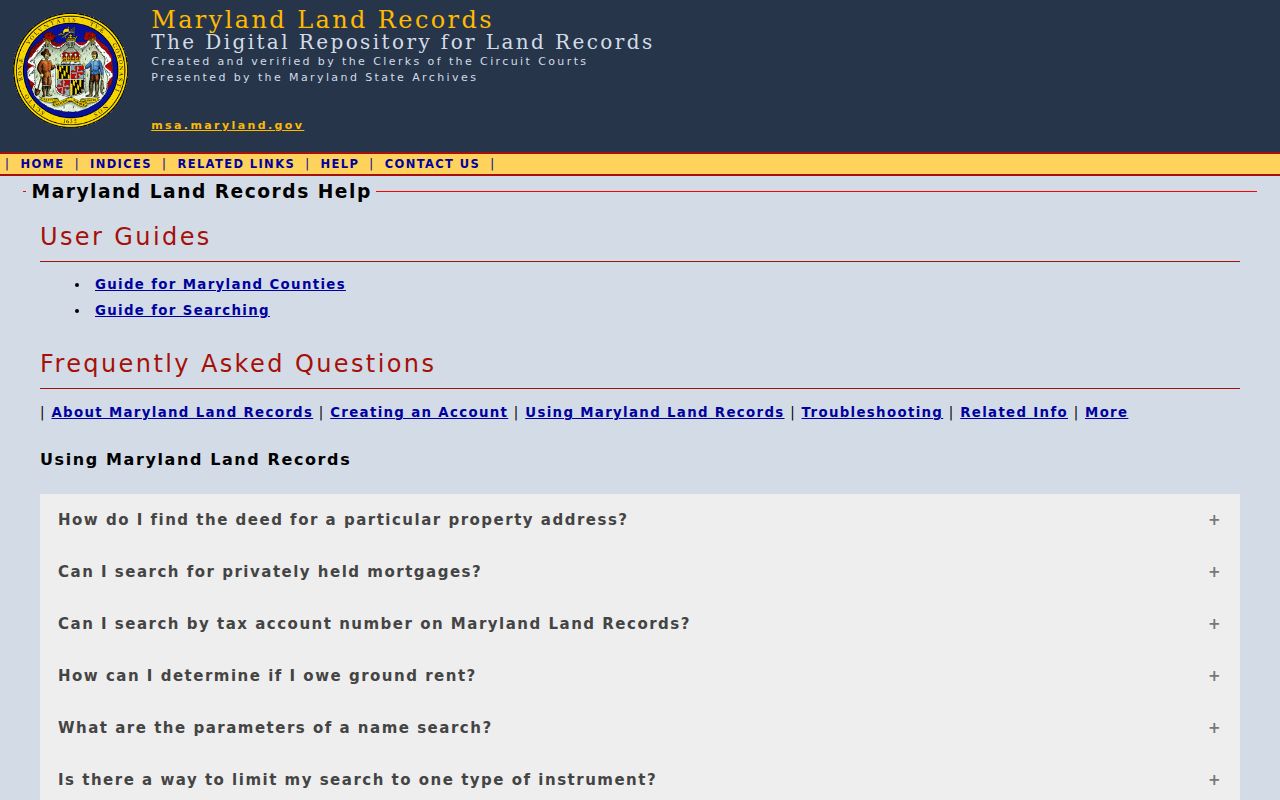
The controls separate grantor from grantee. They also narrow a date and move an SDAT book and page to the correct land-record reference. Online images require a free account. Check payment terms at the time of use.
When the online trail stops, the Clerk’s land-record room at 100 W Patrick Street is the next stop. Public terminals and copy requests both work there. Maryland State Archives indexes, local-history collections, and the land room at 301-600-1957 supply the rest, with recording questions at 301-600-1965.
Follow the Frederick Deed Chain Back
A chain of title anchors Frederick previous-residents work. That is the sequence of recorded ownership transfers. The city’s old-house research guide tells you what to capture from each deed. Get the liber and folio first. Then note grantor and grantee, conveyance and recording dates, boundaries, acreage, land-grant names, and price or tax-stamp clues. Watch for “Being all the same parcel.” That phrase points to an earlier liber or folio. Copying the wording exactly bridges a modern parcel to an older description.
- Record the current SDAT situs, PAN or parcel, legal description, and deed book and page.
- Locate that instrument in MDLandRec or through the Circuit Court Clerk, then capture its date, party roles, prior reference, lot or acreage, and any representative capacity.
- Search the seller in the grantee index for the earlier acquisition, while also checking the grantor index and date or instrument filters to avoid a same-name match.
- Repeat one instrument at a time. When a record refers to an older book, use the Clerk, Maryland State Archives land series, or shelves and terminals described in the city guide.
- Only after the legal chain is dated, pair it with directories, newspapers, census, obituary, cemetery, or probate sources for household evidence.
- Grantor and grantee
- The grantor transfers an interest; the grantee receives it. Either can be an individual, organization, trustee, heir, or representative.
- Chain of title
- The documented sequence of transfers affecting the same parcel or legal description.
- Legal description
- The recorded land description, such as lot, block, metes and bounds, acreage, or plat reference. It often survives when a street form changes.
Note: A deed can name trustees, heirs, executors, witnesses, or neighbors. Not every named party lived there.
Frederick Previous Residents in Directories
Directories supply the occupancy layer that deeds never show. The Maryland State Archives guide offers two leads. One is an 1875 Boyd’s business-directory listing. The other is a microfilm route described as 1875–1911. Individual Frederick volumes and pages still need verification. MSA also lists a Frederick City Directory from 1967 and a 1976 Polk’s accession. The Library of Congress holds Frederick County White and Yellow Pages from 1937/38 through 1943/44. A listing is dated evidence of an address or business association. It proves neither title nor a full household.
The Frederick city directory collections page gives holding details and how to read an entry. For a house trail, record the directory year, page, exact spelling, printed address, and source image. Compare the date to the deed chain before treating any name as a previous resident.
Frederick Past Households and Evidence
Pair directory years with census and family-history sources, since neither stands well alone. A census lists one household on its census date. A telephone entry names a subscriber. An obituary may mention relatives, a last residence, church, cemetery, or a former address. FCPL’s Linton Obituary Collection holds more than 250 surname-organized card drawers reaching back to 1932. Call or write the Maryland Room a week ahead for staff-assisted lookup.
Heritage Frederick keeps more than 1,000 files on citizens, buildings, towns, events, and organizations. It takes research appointments. Maryland State Archives probate guides are useful confirmation routes. So are the Register of Wills, cemetery offices, and church collections. Keep a source log. Note each person’s role in every record. A carefully dated directory, obituary, census, and deed can corroborate a past household connection. Together they avoid claiming more than the evidence supports.
One Frederick Address Through Time
HABS MD-902 covers 59–61 South Market. It shows how a Frederick address research puzzle comes together piece by piece. Its bibliography pulls from the Williams Frederick Directory City Guide and Business Mirror of 1859–60. It also cites an 1862 Henry Koester confectionary and bakery reference. Deed Liber JWIJC 1 Folio 83 adds recorded title facts. Will GME2 Folio 96 adds testamentary facts. Sanborn map years from 1887 to 1930 round out the building picture.
The lesson is simple. No single source stands in for all previous residents. Each record captures a different kind of fact, whether legal, commercial, testamentary, or structural. So a full trail needs several of them working together. Start with the MDLandRec index and landing route. From there you can run a book or party search in the land-record system.
To build on the South Market example, verify in sequence: the HABS bibliography page, the directory page, then the deed and will themselves. Move next to map plates and local newspaper or obituary material. That order keeps a business connection distinct from a recorded title link and from a dated household lead.
Frederick Old Address Forms and Maps
Old Frederick records rarely use modern street numbers. Instead, expect county descriptions, tract names, neighboring proprietors, roads, creeks, acreage, or the spelling Frederick-Town. The record route also shifts over time. Early periods lean on land, court, church, will, tax, and estate material. Later periods turn to directories, newspapers, maps, and probate. Sanborn maps from 1887, 1892, 1897, 1904, 1911, 1922, and 1930 document building footprints and street context. They are not resident registers.
The city plan itself describes long narrow downtown lots. A different 1894 pattern appears at Clarke Place. City and county maps, plats, deeds, HABS material, and the 1988–2020 planning and annexation studies help determine whether an old address sat inside the municipal boundary. Frederick publishes no official citywide street-renumbering year. Keep each older address form as written rather than silently converting it.
Frederick Previous Resident Proof Gaps
Previous residents research has natural limits. A legal owner is not necessarily an occupant. A business, mailing, or post-office address is not necessarily a home address. Directories carry publication lag. A county or postal label can cross a city boundary, so the same block may sit under two labels. The safest conclusion names the source, the date, and the exact address form. It also names the record's role and whatever uncertainty remains. Protected addresses, sealed material, current vital certificates, and motor-vehicle records are not ordinary address-research sources.
Lawful use. Frederick house-history research supports family history, estate work, property context, and personal curiosity. Do not use dated address material to track, harass, or reconstruct the protected location of a living person.
Maryland Safe at Home can place a substitute address in covered government records. Under the Maryland Public Information Act, you may request an existing index, map, permit log, or correspondence from the custodian. The law does not require a new prior-occupant list to be created.
Frederick Land Series After the Fire
Frederick's courthouse history is a reason to verify a record series. It is not a reason to assume the trail ends. Maryland State Archives material describes the 1861 courthouse fire. The same material reports that no major record series appears incomplete. Land records run from 1748 onward. Indexes cover 1748–1915 and again from 1867, and plat books begin in 1909. The physical courthouse changed. Even so, early property research still moves through Clerk, archive, and series-level routes.
Cite the source date, series title, book or folio, and repository in your final note. That method exposes real gaps. It also makes a Frederick previous residents trail reproducible for whoever follows.